
Remodeling Marketing: Where Your Website Fits
Referrals, Google, social, yard signs. Almost every kind of remodeling marketing ends the same way: someone looks you up. Here's where your website fits, and where I'd start.
When I get on a first call with a remodeler, I start by asking about the business and where things feel stuck. The answer tends to be some version of "I want more leads," "my website doesn't feel like us anymore," or "the business changed and the site never caught up." Nobody opens with "I need a remodeling marketing plan." But when we dig in, that's usually what we end up talking about, and the website keeps turning out to be the piece holding the rest back.
Most of what I know about getting a small business seen online, I learned through trial and error on my own work. I've been pulled through the fire a few times. So this is how I think about it now: where your website sits in your marketing, what it has to do, and how everything else feeds into it.
Where your website fits in remodeling marketing
Think about how a homeowner actually finds a remodeler. A neighbor recommends you. They see your yard sign or your truck. Someone mentions you in a local Facebook group. They search "kitchen remodeler near me" and your name shows up on the map.
Different starting points, same next step: they look you up. They open your website, usually on their phone, and decide in a few seconds whether you feel like the right fit. That moment is where a lot of marketing quietly wins or loses.
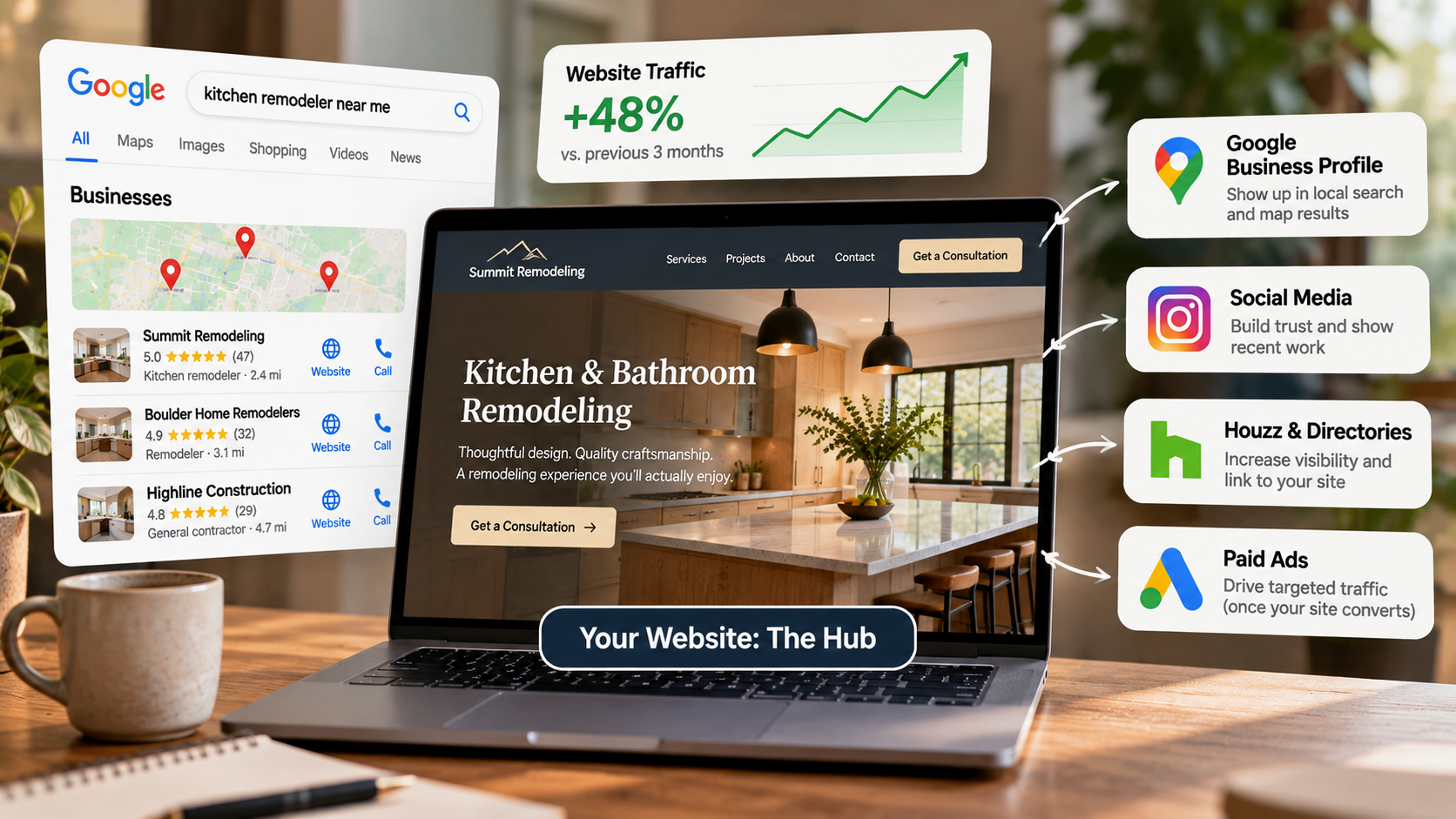
That's why I think of the website as the hub. Every other channel sends people to it, and if the site doesn't hold up, it doesn't matter much how good the referral was.
Referrals start the conversation. Your site has to finish it.
Most remodelers I talk to get most of their work from referrals, and that says good things about their work. A lot of owners figure that if the referrals are strong, the website doesn't really matter. It's like, no, the website is usually the first place that referral goes. Someone hears your name, and the next thing they do is look you up.
If what they find looks dated or doesn't show the kind of project they're planning, the referral cools off, and you'll probably never know it happened.
Search matters too, especially in the slower months. I wrote about that, and about what I found going through 78 remodeler websites this fall, in How to Get More Remodeling Leads From Your Website.
What the site has to do on that first visit
A homeowner landing on your site is skimming for a few answers: do you do my kind of project, do other people trust you, what happens if I reach out, and how do I do that.
If those answers are on the first screen or close to it, the rest of your marketing gets to do its job. If they're buried, every channel leaks a little at the last step. The fixes are usually simple: reviews and credentials near the top, finished projects organized by type, a short "how it works" section, and one clear button for a consultation. I pulled apart two real sites that handle this differently in Best Contractor Websites: Examples & What Makes Them Convert.
Where the other channels fit
Once the website can carry its weight, the other channels make a lot more sense. Here's how I'd think about each one:
- Google Business Profile. Often the first place a local homeowner sees you, through the map results. Keep the category, service area and photos current, and link it to your site. I went through this in Remodeling SEO.
- Social media. Mostly a credibility check. People look you up to see whether the work is real and whether you're still active. More on that in Social Media for Home Builders.
- Houzz and directories. Worth having a complete profile that links back to your site. Treat them as listings, not as your home base.
- Yard signs, trucks and home shows. Still useful for a local business. Put your website on them, not just a phone number, because a lot of people will look you up before they call.
- Paid ads. It's not to say ads can't work. They can. But they amplify whatever your site already does, so I'd hold off until the site is turning visitors into consultations. Otherwise you're paying to send people somewhere that doesn't convert.
The strongest remodelers use every avenue
The companies that always seem to have a full schedule usually aren't doing anything magical. They just don't settle for mediocre marketing. Their referrals land on a site that looks as good as their kitchens. Their Google profile is current. Their trucks have the website on them. Each piece is small, and together they add up.
Keeping all of that up on top of running jobs, managing crews and taking care of clients is a tall ask. It's completely reasonable to get help with some of it. Just make sure whoever helps you starts with the website, because everything else points back to it.
Where I'd start
Look yourself up the way a homeowner would. On your phone, search your company name, tap through to your website, and give it ten seconds. Does what you see match the quality of the work you actually do? Is it obvious how to get in touch?
If the answer is no, that's the first piece of your marketing to fix, before spending more on anything else. When I work with someone on this, I ask a lot of questions first, about the business, the projects they want more of and where people are getting stuck, and then give an honest picture of where the site could realistically be. If you'd like to see how I approach it, my contractor website design page walks through it.
See how I plan and build Webflow sites for remodelers and design-build firms, and what the process looks like.
Learn more